
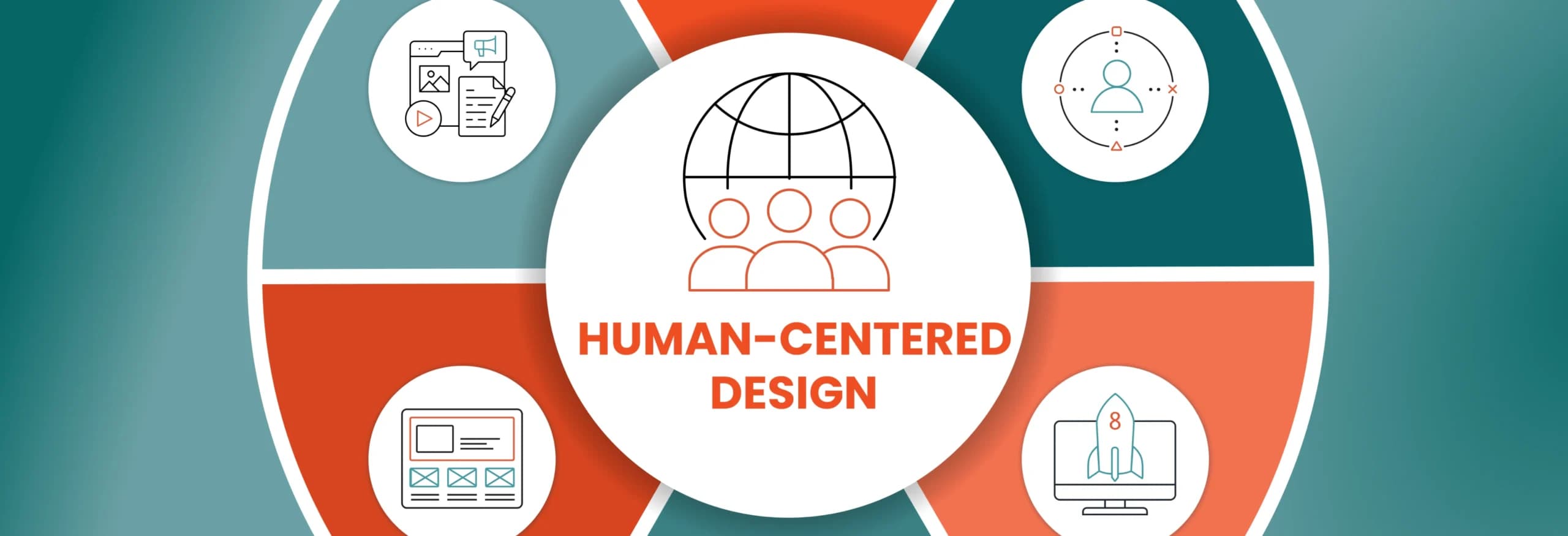

At Integrity, we believe human-centered design isn’t just a trendy buzzword; it’s the foundation of every great digital experience. It means putting real people at the center of everything we create, from early strategy to final development. Because in our view, your user experience is your brand.
That belief is ingrained in how we work and think. It’s not just about beautiful design, clever content, or powerful tech (though we love all three). It’s about how all of those things come together to solve problems and create a meaningful, intuitive, and effective experience for the people who matter most: your users.
A gorgeous interface that’s frustrating to use? Still a frustrating product. If something feels broken to a user, it is broken.
Human-centered design (HCD) helps our design team avoid those pitfalls by focusing on deep empathy, accessibility, and usability from the start. It’s the heart of the process.
In this post, we’ll share how Integrity applies principles of human-centered design thinking across digital strategy, UX/UI, and development, and why it leads to better results. You’ll see how we blend business goals with real user needs to create solutions that not only look great but also work hard for your audience.
Designs That Forgot About the Humans
Real-World Examples
You’ve seen them. Maybe you’ve even cursed at a few.
- A digital billboard with six lines of text in a tiny font, impossible to read as you fly by at 70 miles per hour.
- A QR code on a product label that leads to an old, clunky desktop website. Good luck navigating it on your phone with your fingers!
- A chatbot icon that blocks a web form button on mobile devices, making it impossible to submit!
- A website for older adults using a tiny, light gray font that’s so unreadable that you have to zoom 150%!
- A web form with the “Next” button placed in the bottom right corner that feels miles away on a large monitor.
- Two-factor authentication (2FA), where the special code is never received.
What do all of these have in common? They forgot the human on the other side—the real person who’s driving, scanning, reading, or trying to get something done. When design decisions ignore context, ability, or behavior, the result isn’t just bad design, it’s a broken experience. And broken experiences break trust.
Human-centered design starts with empathy, not aesthetics.
What Human-Centered Design Really Means to Us
It’s a Mindset, Not a Method
At Integrity, our HCD approach is a mindset. It’s how we approach every project, every problem, every conversation. We don’t assume. We ask. We listen. We dig in to understand not just what users do, but why they do it.
This mindset shows up in our culture, not just our deliverables. Yes, we have a team with diverse backgrounds and skills, but more importantly, we’ve built a human-centered design process that turns that range of perspectives into real insight.
Discovery That Goes Deeper
Our Discovery process is a great example. It’s not just about gathering technical requirements; it’s about uncovering the deeper needs of the business and the humans it serves. We align on goals and milestones, review documentation, and clarify the problems we need to solve.
We keep real people at the center of the project from day one.
- Talk to subject matter experts
- Conduct user research
- Review market research
- Gather user feedback
- Build out customer personas
- Refine target audience segments
- Map out customer journeys
We believe the best solutions come from collaboration, not silos.
That’s why we design with our clients and their users, not just for them. Whether we’re running a design sprint, mapping a user flow, or planning a release, co-creation and clarity are key. User-centered design helps us get everyone moving in the same direction, toward outcomes that are smart, scalable, and actually work for the people using them.
Objective Design and Human-Centered Design Go Hand in Hand
At first glance, objective design and human-centered design might seem like opposites—one driven by data, the other by empathy. But in practice, they support each other. Objective design helps us ground creative decisions in real insights from our discovery process: analytics, user behavior, accessibility standards, and business goals. It ensures we’re not only just designing something that looks good, but also we’re designing something that works.
Human-centered design brings the heart to the process behind your creative approach. It reminds us that behind every data point is a real person trying to accomplish something. When we blend both methods, we get digital experiences that are not only effective and efficient but also intuitive, inclusive, and engaging, all with user satisfaction in mind. In other words, we’re not guessing. We’re designing with purpose, and with people in mind at every step.
Why Human-Centered Design Matters More Than Ever
Tech Moves Fast. People, Not So Much!
New platforms, new devices, new expectations. Every month brings something shiny and new. But here’s the thing: human needs don’t change nearly as quickly. People still want clarity, ease, and connection. They still want to feel understood.
Designing for Everyone from Boomers to Gen Alpha
Your users might be:
- Editing a TikTok video on their phone
- Squinting at a desktop monitor
- Looking for the “print” button they swear used to be there
If your experience isn’t intuitive and accessible across generations, you’re losing trust and users.
That’s why HCD is more important than ever. Especially now, when brands are trying to connect with everyone from Gen Alpha to aging Baby Boomers, some of whom grew up with screen time rewards and some of whom still prefer desktop over mobile.
In a noisy digital world, user empathy is a real competitive advantage.
Across Devices and Generations
A truly human-centered experience must work for all your users in the real world, whether they’re using the latest iPhone, an aging Android tablet, or a desktop with accessibility tools. That’s why QA can’t be an afterthought. Usability testing should leave no screen, scroll, or click unturned.
We test across various devices, browsers, screen sizes, and user types to ensure that nothing slips through the cracks. We mimic human behavior, and with real humans doing the user testing! From Gen Z power users to Baby Boomers with reading glasses, we’re focused on making sure every interaction is smooth, intuitive, and frustration-free, because good design fails fast if it doesn’t function everywhere your audience shows up.
When you create experiences that minimize friction and respect your audience’s abilities and preferences, you foster trust. And trust is what keeps people coming back. Human-centered design helps us get there by designing with care, with intention, and with the end user in mind at every step.

How We Apply Human-Centered Design at Integrity
Each of these disciplines plays a unique role, but they all orbit around the same core idea: put people first. Here’s how each one contributes to a human-centered approach:
- Design Thinking – Empathy-driven problem solving from day one
- User Experience (UX) – Creating intuitive, meaningful digital interactions
- Service Design – Orchestrating every touchpoint across the full user journey
- Creative Intelligence – Applying emotion, insight, and storytelling to design
- Systems Thinking – Considering the ripple effects of every decision
- Learner Experience (LX) – Designing with curiosity, clarity, and retention in mind
Together, they form a holistic, people-first approach to strategy, design, and development.
At Integrity, human-centered design isn’t one step in our process. It is the process.
A Human-Centered Culture, Too
Human-centered design isn’t just something we deliver; it’s something we live. The way we collaborate with clients mirrors how we work with each other through:
- Open communication
- Shared goals
- Mutual respect
- Team-first mindset
We don’t just hand off tasks or assign tickets. We ask questions, challenge assumptions, and stay curious because building great experiences requires great teamwork, inside and out.
Our holacracy model plays a big role in that. It provides our team members with clarity on roles, responsibilities, and expectations, while also allowing for autonomy and ownership. Instead of rigid hierarchies, we operate through dynamic circles and structured collaboration. That means everyone has a voice, and we’re all aligned on what success looks like, from kickoff to launch. It’s a system built for transparency, accountability, and partnership, which is reflected in the quality of our work.
Put People First, Always
HCD isn’t a nice-to-have; it’s a must-have. Attention is limited and expectations are high, so the experiences you create are just as important as the products or services you offer. And those experiences start with understanding the humans on the other side of the screen.
Whether you’re a marketer planning a website redesign, a founder launching a new web application, or a product owner looking to improve e-commerce conversion, putting people first will always lead you in the right direction.
That’s where Integrity comes in. If you’re ready to build digital experiences that are intuitive, inclusive, and rooted in your users’ needs, let’s talk!
Additional Resources